
Review · NORTHERN CYPRUS TOURS
A Day Trip to Medieval FAMAGUSTA (Kyrenia, Nicosia or Famagusta )
Cyprus saves its biggest surprises for the east. This private day trip links St. Barnabas Monastery, the ancient ruins of Salamis, medieval Famagusta, and the abandoned quarter of Varosha in about seven hours. I like the private guide and flexible pace, and I like how the day moves from religious history to Greek and Roman ruins, Gothic architecture, and modern political memory. The chance to travel with guide Sirin, praised for her warmth, humor, and strong storytelling, adds real value.
The main drawback is the packed schedule. You have about two hours at St. Barnabas, one hour at Salamis, and roughly an hour for each Famagusta stop, so this is a highlights tour rather than a slow archaeological visit. Hotel pickup is offered from central Kyrenia hotels, but pickup elsewhere can cost extra, and lunch is not included.
In This Review
- Key points to know before booking
- Why this Famagusta day trip works
- St. Barnabas Monastery and the hidden tomb
- Salamis, where myth meets Roman public life
- Walking through Famagusta’s medieval walls
- Lala Mustafa Pasha Mosque and a Gothic cathedral’s second life
- Namık Kemal’s prison in the Venetian palace
- Varosha, the abandoned resort quarter
- A private guide can shape the whole day
- Who should book this day?
- FAQ
- Where does the tour begin?
- Can I be picked up from Nicosia or Famagusta?
- How long does the experience last?
- Is this a private tour?
- What language is the tour offered in?
- Are entrance tickets included?
- Is lunch included?
- How much does the tour cost?
- Can I cancel or change the booking?
- Should you book this Famagusta tour?
Key points to know before booking
- Six major stops in one day: You visit St. Barnabas, Salamis, Famagusta’s walled center, Lala Mustafa Pasha Mosque, Namık Kemal Museum, and Varosha.
- A genuinely private outing: Your group alone joins the activity, with a driver-guide and the freedom to ask questions or adjust the pace within the day.
- Sirin earns especially warm praise: Her humor, local connections, and passion for Cyprus history are repeatedly highlighted.
- Salamis needs comfortable walking shoes: The ancient site includes a gymnasium, theatre, and Roman baths, with uneven outdoor ground likely underfoot.
- Varosha is the emotional centerpiece: The abandoned resort quarter gives the day a modern and unsettling edge beyond the usual monuments.
- The $360.07 price covers up to four people: For a full private vehicle, guide, transfers, bottled water, and site tickets, the cost can make sense for a small group.
Why this Famagusta day trip works
Famagusta is not a one-note destination. Its story includes early Christianity, a Greek foundation myth, Roman public buildings, Lusignan Gothic design, Venetian defenses, Ottoman rule, and the divided island of modern Cyprus.
That range is the best reason to choose this trip. Instead of spending the whole day inside one old town, you see how different periods overlap across northeastern Cyprus. St. Barnabas gives you religious and local context. Salamis offers a large archaeological site. Famagusta supplies medieval streets and buildings. Varosha brings the story into the twentieth century.
I also like the private setup. With a group limit of four, you do not have to wait for a large coach to load or listen to a guide address dozens of people. You can ask about a detail that catches your eye, spend a little longer at a favorite stop, or keep moving if a site is not holding your attention.
The day begins around 9:30 to 10:00 in the morning and lasts about seven hours. Pickup and return are included from selected centrally located hotels in Kyrenia, with the Bella View Art Boutique Hotel listed as a meeting point. Pickup from other cities may involve an additional charge, so check your exact hotel before paying.
More day trips up into the north:
- Ghost-Town Famagusta Mini Bus Tour from Protaras and Ayia Napa
★ 4.5 · 298 reviews - Full-day Famagusta: Lost Cities & Coastal Secrets from Paphos
★ 4.5 · 274 reviews - Red Bus Varosha experience in English from Ayia Napa, Protaras
★ 4.5 · 88 reviews
St. Barnabas Monastery and the hidden tomb
The first stop sets a spiritual tone for the day. St. Barnabas Monastery and Icon Museum tell the story of Barnabas, a Jewish man who studied in Jerusalem before embracing Christianity and returning to Cyprus to spread the faith.
According to the story shared on the visit, Barnabas was killed by opponents of his teachings. Believers buried him in a cave beneath a carob tree, then fled as far as Egypt while the location faded from memory. His tomb was later found, giving the site its lasting importance.
You spend about two hours here, making it the longest stop of the morning. That is useful because the complex is more than a quick photo opportunity. You have time to visit the tomb, see the icon collection, and hear the local account of how the burial place was identified.
The museum gives the stop a quieter feel than the larger ruins later in the day. I would pay close attention to the guide here, since the value comes largely from the explanation of Barnabas and the religious traditions surrounding the monastery. Without that context, you might see an old monastic complex and move on without grasping why it matters.
Admission is included. You should still dress for a day that mixes indoor and outdoor sightseeing, since the itinerary continues directly to an open archaeological site.
Salamis, where myth meets Roman public life
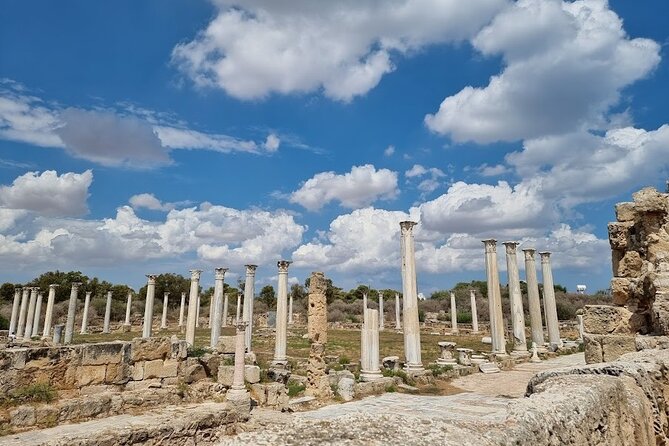
Salamis is the day’s main ancient site. Its legendary foundation is tied to Teucer, a hero of the Trojan War who was exiled from the Greek island of Salamis after failing to protect his half brother Ajax. He sailed to Cyprus, founded a new kingdom, and gave it the name Salamis.
You have about an hour to explore with your guide. That is enough to see the principal highlights, but not enough for a slow examination of every surviving structure. The key sights include the gymnasium, theatre, and Roman baths.
The gymnasium helps you picture Salamis as a place of exercise and public life, not simply a collection of broken stones. The theatre gives the site a sense of scale and reminds you that entertainment was part of the ancient city’s daily rhythm. The Roman baths add another layer, showing the public comforts and social customs associated with Roman urban life.
I would treat this stop as a guided introduction rather than a full archaeological study. Your guide can point out what you are looking at and connect the ruins to the city’s mythic Greek origins and later Roman period. If ancient sites are your main interest, the one-hour limit may feel short. If you want a broad day with several very different stops, the timing keeps the trip moving.
Wear practical shoes and expect outdoor walking. The tour requires a moderate level of physical fitness, and the ruins are not presented as a purely drive-up attraction. Site admission is included, which removes one small task from the day.
Walking through Famagusta’s medieval walls
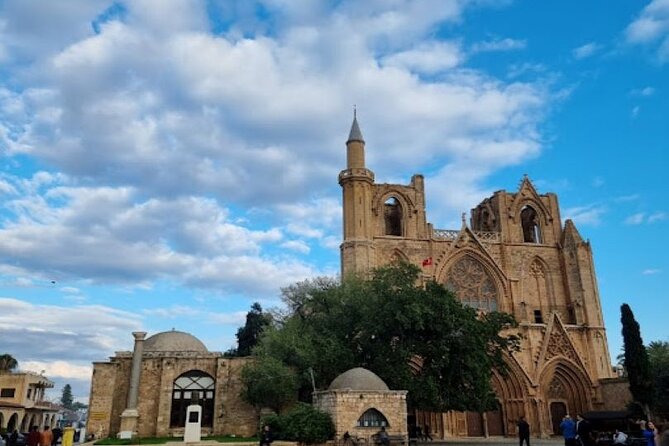
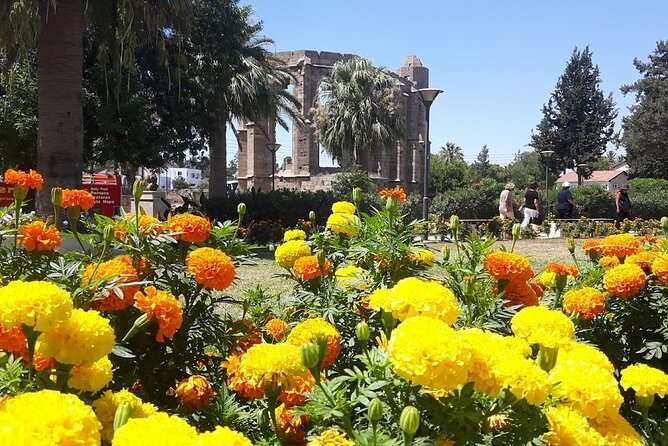
After Salamis, the focus shifts from ancient Cyprus to the medieval walled city of Famagusta. The Lusignans built the original walls, and the Venetians later added to the defenses. Inside, surviving buildings reflect several powers that ruled or shaped the city.
The walking portion lasts about an hour. You will see historic streets and major monuments rather than every corner of the old town. The compact format is practical because Famagusta’s appeal comes from the way the buildings appear together, with layers of architecture close at hand.
This is also where a private guide becomes especially useful. Medieval walls, converted churches, Ottoman-era buildings, and Venetian remains can blur together if you do not know what you are seeing. A guide can explain how the city changed hands and why its buildings carry more than one identity.
Do not expect a polished open-air museum. The interest here lies partly in the mixture of old structures and modern life. The tour gives you a guided introduction, then concentrates on specific monuments within the historic center.
A few more Cyprus trips worth comparing
- NORTHERN CYPRUS ALL-IN-ONE Private Day Trip from Nicosia
★ 5.0 · 89 reviews - Aphrodite’s Birthplace, Lefkara & Kourion Day Trip from Paphos
★ 4.0 · 20 reviews - Paphos: Aphrodite’s Birthplace, Lefkara & Kourion Day Trip
★ 4.1 · 9 reviews - Day Trip to the Paphos amazing sides from Limassol.
★ 5.0 · 6 reviews
Lala Mustafa Pasha Mosque and a Gothic cathedral’s second life
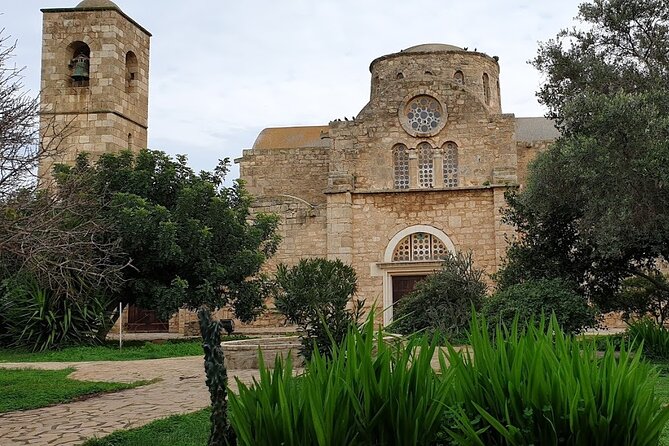
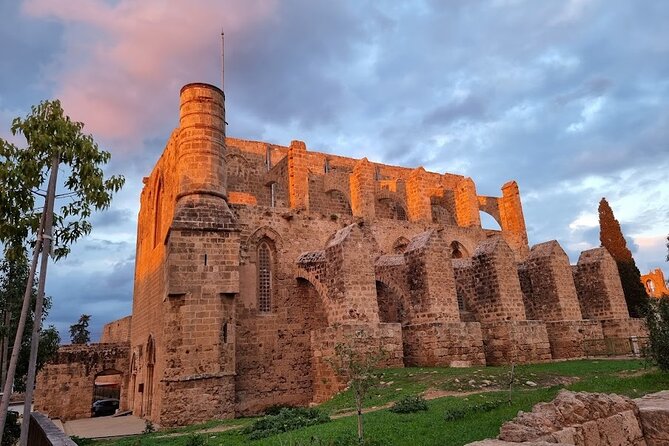
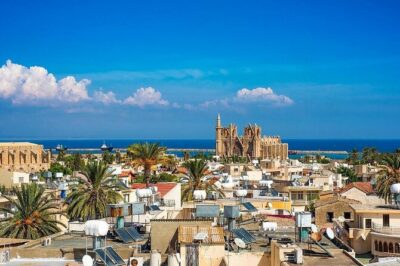
The Lala Mustafa Pasha Mosque is one of Famagusta’s most striking buildings. The Lusignans built it as St. Nicholas Cathedral between 1298 and 1312, using Gothic forms associated with the great churches of medieval Europe.
The cathedral served as a place where Lusignan kings were crowned as Kings of Jerusalem. After the Ottoman conquest of Cyprus, the building was converted into a mosque. A minaret was added, and the building first took the name Ayasofya before becoming known as Lala Mustafa Pasha Mosque.
That change of function is the point to watch for. You are not simply seeing a Gothic church or a mosque. You are seeing one building altered to suit new rulers, new worship, and a new political order.
The visit lasts about an hour and admission is free. The famous Ficous Sycomorus tree beside the building is said to date to 1299, adding a living detail to the stone setting. The tree is easy to overlook, so it is worth asking your guide to point it out.
Because the building remains a mosque, follow the guide’s instructions about appropriate behavior. The tour description confirms that it is still used for worship, so this is a functioning religious place, not just a monument.
Namık Kemal’s prison in the Venetian palace
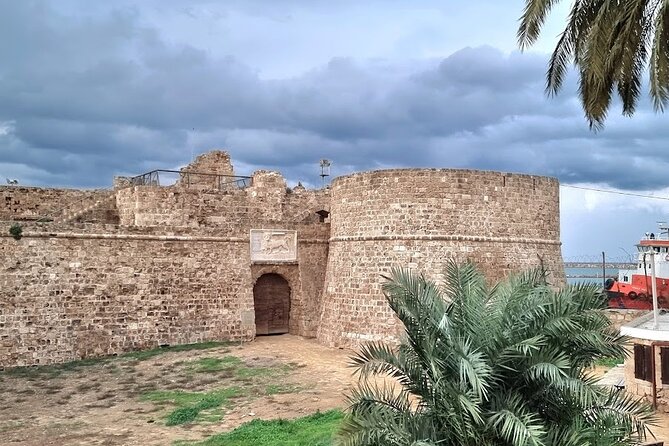
Namık Kemal Zindanı ve Müzesi offers a smaller but more personal stop. During Ottoman rule, Famagusta served as a place of exile. Namık Kemal, a writer who opposed the Sultan, was imprisoned here and spent 38 months in Famagusta.
His prison is within the Venetian palace, and a statue of him faces the square named in his honor. The statue was replaced in 1953. These details make the stop more than a quick look at an old cell, since the guide can explain Kemal’s writing, political opposition, and connection to the city.
You have about an hour here, although the overall walking tour links this stop with the other central sights. I like this part of the day because it shifts attention from kings and conquerors to one individual whose words brought him into conflict with power.
If literary history is not your main interest, this may feel less immediately dramatic than the cathedral or ancient theatre. Still, it adds human scale to Famagusta and shows how the city continued to serve political purposes long after its medieval walls were built.
Varosha, the abandoned resort quarter
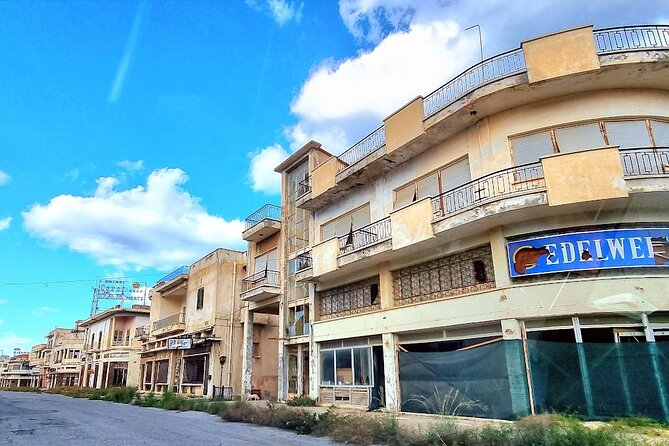
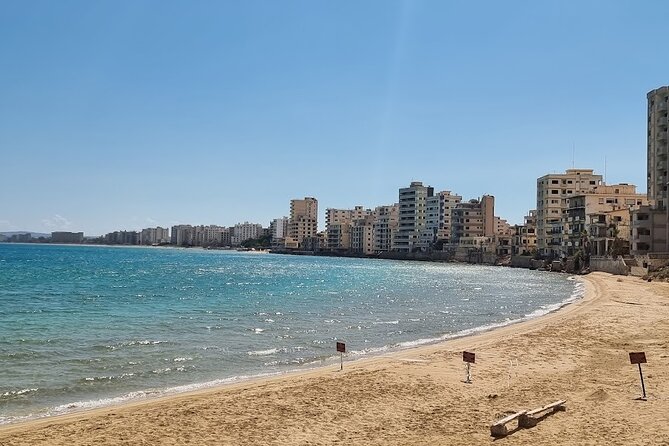
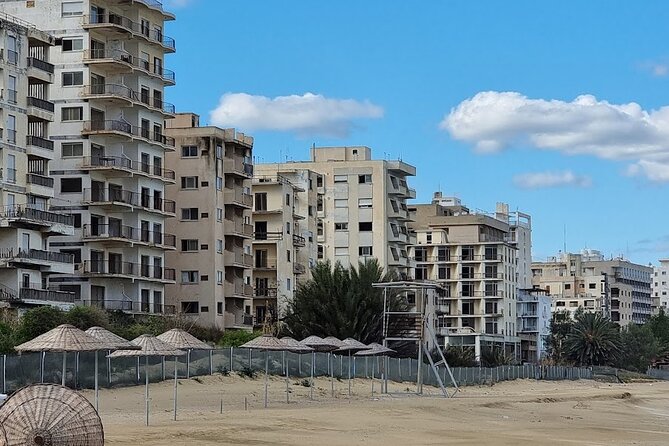
Varosha, often called Famagusta’s ghost town, is likely to be the most memorable stop. Before its abandonment, it was known for houses, hotels, tourists, and a busy resort life. It was abandoned in 1974 and reopened after 46 years.
The tour includes about an hour walking in the area while your guide explains what happened and how the quarter fits into Cyprus’s modern story. The contrast is stark: a place built for holidays, then left largely frozen after conflict and division.
This stop gives the day its strongest emotional weight. Ancient Salamis can feel distant, while Varosha points to a political issue that still shapes life on Cyprus. You are not only looking at old architecture. You are trying to understand how a functioning resort became an abandoned urban quarter.
The experience can also feel sensitive. Listen carefully to the guide and avoid treating the area as a simple curiosity or photo backdrop. Sirin received particular praise for explaining Varosha clearly and making it a highlight without losing sight of its difficult history.
The exact access and viewing conditions may change over time, so you should follow local instructions during the walk. The tour description says Varosha reopened after 46 years, but it does not promise access to every building or street.
A private guide can shape the whole day
The price is $360.07 per group of up to four people, rather than per person. That distinction matters. A couple pays the same group rate as a family or small party of four, so the value improves as you fill the vehicle.
The cost includes fuel surcharge, bottled water, driver-guide service, hotel pickup and drop-off from selected hotels, private touring, and tickets for the historical sites. Lunch is not included. Several people specifically praised Sirin for making the day welcoming, adding humor, and explaining Cyprus with enthusiasm. One account also noted that she took the group to a local restaurant where she was known and helped them feel welcome.
That lunch detail is not guaranteed as part of the published inclusions, so treat it as a possible guide recommendation rather than a promised feature. You should plan for lunch costs separately and ask about timing on the morning of the tour.
For four people, the price works well if you value a private car, personal explanations, and door-to-door transport. For one person, it is a much larger expense. A small private group also lets you avoid the fixed rhythm of a big bus tour, but the seven-hour schedule still limits the time at each individual site.
The high rating and full recommendation record support the guide-led format, especially for visitors who want history explained rather than simply photographed. Still, praise for the guide should not lead you to expect an unlimited custom itinerary. The day has six defined stops and a firm overall duration.
Who should book this day?
I would recommend this tour to first-time visitors based in Kyrenia who want a broad introduction to northeastern Cyprus. It suits couples, families, and groups of friends who can share the $360.07 price.
It is also a good choice if you want to combine ancient ruins with medieval buildings and modern political history. Few single-day outings offer such a wide time span without requiring you to plan several separate transfers.
You should think twice if your priority is a long, slow visit to Salamis or a detailed study of every Famagusta monument. The schedule is designed for range. You see many important places, but you do not get half a day at any one of them.
A moderate level of physical fitness is expected. You will walk at the monastery, the ruins, the old town, and Varosha, so comfortable shoes and water are sensible. Bottled water is provided, but lunch is on your own.
The experience is offered in English, with confirmation at booking. It is non-refundable and cannot be changed for any reason, so check your date, hotel, group size, and pickup location carefully before booking.
FAQ
Where does the tour begin?
Pickup is offered from centrally located hotels in Kyrenia. Bella View Art Boutique Hotel is listed as a meeting point, and the activity returns to the meeting point at the end.
Can I be picked up from Nicosia or Famagusta?
The tour description says pickup can begin in Kyrenia, Nicosia, or Famagusta. It also states that pickup from selected hotels in Kyrenia or Famagusta is included, while other cities may require an extra charge.
How long does the experience last?
The full experience lasts approximately seven hours. Pickup is generally scheduled between 9:30 and 10:00 in the morning.
Is this a private tour?
Yes. Only your group participates, with a maximum of four people per booking.
What language is the tour offered in?
The experience is offered in English.
Are entrance tickets included?
Yes. Tickets for the historical sites are included. The Famagusta walled city, Lala Mustafa Pasha Mosque, Namık Kemal Museum, and Varosha stops are listed as free admission.
Is lunch included?
No. Lunch is not included in the price. Bottled water is included.
How much does the tour cost?
The listed price is $360.07 per group of up to four people. The price includes the driver-guide, fuel surcharge, bottled water, included hotel transfers, private touring, and historical-site tickets.
Can I cancel or change the booking?
No. The experience is non-refundable and cannot be changed for any reason. If you cancel or request an amendment, the amount paid will not be refunded.
Should you book this Famagusta tour?
Book it if you want a well-rounded private day with a strong guide, convenient pickup, and a clear route through Cyprus’s eastern history. The best parts are the variety, Sirin’s praised storytelling, and the chance to see Varosha alongside Salamis and medieval Famagusta.
Skip it if you want a relaxed archaeological day or dislike fixed sightseeing schedules. For a group of three or four, the price offers solid value. For a solo visitor, it is harder to justify unless private transport and personal guiding matter more than keeping costs low.
Recently added around Cyprus
- Private cruise with a sailing yacht Koursaros★ 5.0 · 3 reviews
- Taxi transfer from LCA airport to Ayia Napa or Ayia Napa to LCA airport★ 5.0 · 3 reviews
- Luxury Wine tasting at your place in Cyprus★ 5.0 · 3 reviews
- Discover Heritage of Cyprus: Private Tour from Limassol★ 5.0 · 4 reviews
- Pafos and Kourion Coach Excursion in Italian★ 4.0 · 3 reviews
- Private Full-Day Tour in Larnaca with Hotel Pick Up★ 5.0 · 4 reviews
- Watch the stunning sunset over the Akamas on a luxury Speedboat.★ 5.0 · 4 reviews
- Self Drive from Latchi to Blue Lagoon Boat Rental★ 5.0 · 4 reviews
Northern Cyprus Tours, compared.
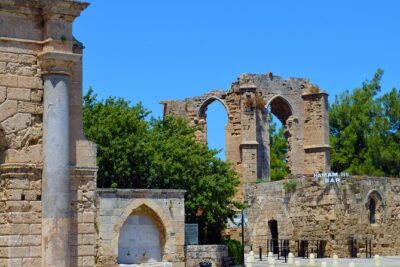
Ghost-Town Famagusta Mini Bus Tour from Protaras and Ayia Napa
Read our review →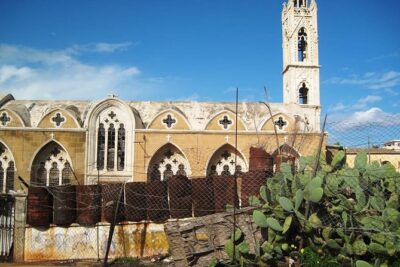
Full-day Famagusta: Lost Cities & Coastal Secrets from Paphos
Read our review →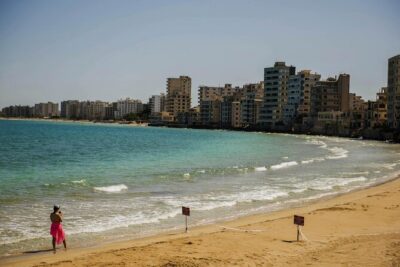
Red Bus Varosha experience in English from Ayia Napa, Protaras
Read our review →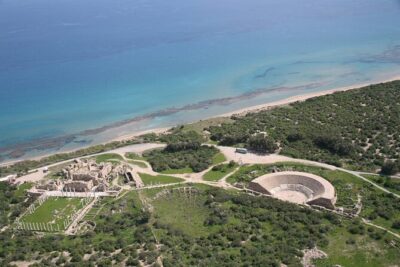
Day Tour to Famagusta, Ghost Town & Ancient Salamis
Read our review →
Famagusta and Blue Lagoon Jeep Safari from Protaras
Read our review →Browse the lists this tour appears in