
Review · NORTHERN CYPRUS TOURS
FAMAGUSTA & NICOSIA Private Tour from Kyrenia
Two cities, ancient ruins, and a divided capital. This full-day tour packs eastern Cyprus and North Nicosia into one private, guide-led outing, with pickup, lunch, and entrance fees included. I especially like the chance to see Salamis and Famagusta in one day, and the personal feel of traveling only with your own group.
The strongest part is the human touch. Guides such as Sedat, a schoolteacher who lived through the 1974 war, and Cemal have been praised for explaining Cyprus from both a historical and personal point of view. The main drawback is the pace: most stops last only 10 to 30 minutes, so you get a broad introduction rather than hours at each site.
In This Review
- Key things to know before booking
- Why this day trip works from Kyrenia
- St Barnabas Monastery and its small museums
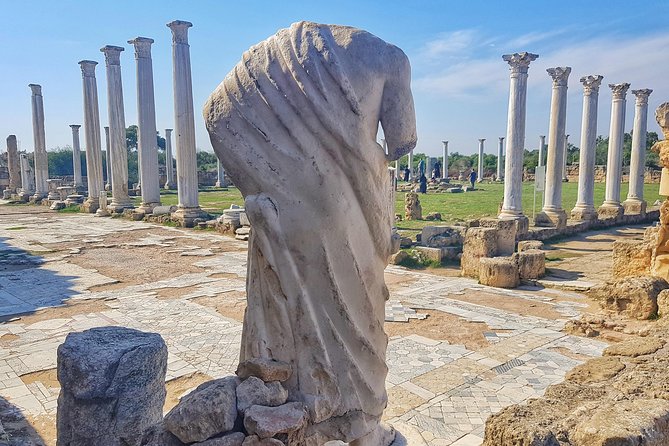
- Salamis: the ancient city’s Roman scale
- Famagusta Walled City and Lala Mustafa Pasha Mosque
- Varosha and the meaning of a ghost town
- Crossing into North Nicosia’s old city
- Buyuk Han and the Ottoman market quarter
- The guide makes or breaks the experience
- Is $222.29 per person a fair price?
- Pickup, timing, and practical details
- Who should book this private Cyprus tour?
- Should you book it?
- FAQ
- Where does the Famagusta and Nicosia tour start?
- Does the tour return to Kyrenia?
- Is hotel pickup available?
- How long does the experience last?
- Is this a private tour?
- Is lunch included?
- Are entrance fees included?
- What language is the tour offered in?
- Can I cancel or change the booking?
Key things to know before booking
- Salamis and Famagusta fit into one eastern Cyprus route: You visit major ancient and medieval sites without arranging separate transport.
- North Nicosia adds a different chapter: The Kyrenia Gate, Selimiye Mosque, and Buyuk Han show the capital’s Venetian and Ottoman layers.
- Lunch and entrance fees are included: That makes the $222.29 per-person price easier to judge, especially for a private vehicle and guide.
- Pickup is limited to the Kyrenia area: Hotel collection is available in Kyrenia, Alsancak, Lapta, and Çatalköy.
- The schedule is brisk: Short visits work well for first-time orientation, but not for travelers who want slow photography or detailed archaeology.
- The tour returns to the starting point: You finish back at the Baldöken parking area in Kyrenia City Centre.
Why this day trip works from Kyrenia
Kyrenia is a convenient base for seeing northern Cyprus, but Famagusta and Nicosia are far enough away to make independent sightseeing more complicated. This tour removes much of that effort. You begin at 9:00 a.m., travel with your own group, and let the guide handle the route, entrance arrangements, and historical context.
I like the structure because the day moves through several distinct periods. You start with religious art and archaeology at St Barnabas, continue to the ancient Greek and Roman city of Salamis, then enter medieval Famagusta. Later, North Nicosia brings Ottoman and Venetian history into the picture.
The route is not designed for a slow, scholarly inspection of every stone. The listed stop times range from 10 to 30 minutes, with Salamis and St Barnabas receiving the longest visits. Driving between sites takes part of the day, too. Think of this as a strong first look at the eastern side of the island, not a deep archaeological field trip.
Because the tour is private, you can ask questions as you go. That matters in Cyprus, where the same church, city wall, or abandoned resort can carry several layers of political and cultural meaning. A guide who can explain those layers plainly is a major advantage.
More day trips up into the north:
- Ghost-Town Famagusta Mini Bus Tour from Protaras and Ayia Napa
★ 4.5 · 298 reviews - Full-day Famagusta: Lost Cities & Coastal Secrets from Paphos
★ 4.5 · 274 reviews - Red Bus Varosha experience in English from Ayia Napa, Protaras
★ 4.5 · 88 reviews
St Barnabas Monastery and its small museums
Your first stop is St Barnabas Monastery and Icon Museum, with about 30 minutes included. The former church now houses a collection of Cypriot icons and other religious objects. It gives you an early look at the island’s Christian artistic tradition before the day shifts toward ruins and city walls.
The monastery also contains a small archaeological museum. Its pottery collection reaches back to around 4000 BC, and complete pieces from different eras help connect the island’s distant past with the later sites you see. The museum is not presented as a huge institution, so you should expect a compact visit rather than a full morning indoors.
This stop works well at the beginning because it gives the day a calm start. You can look closely at artifacts, listen to the guide, and begin placing Cyprus within a much longer timeline. If you are especially interested in icons or pottery, 30 minutes may feel short, so use the time carefully.
The admission fee is included. That saves you from handling separate payments and keeps the day moving.
Salamis: the ancient city’s Roman scale
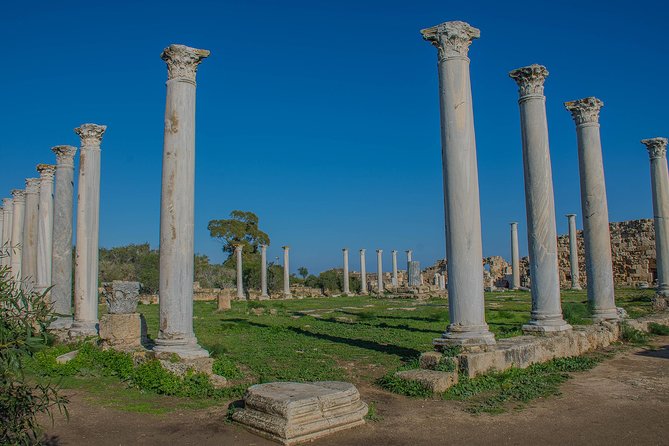
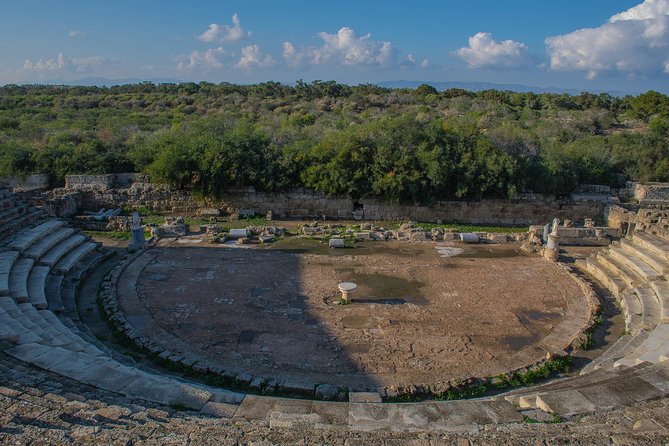
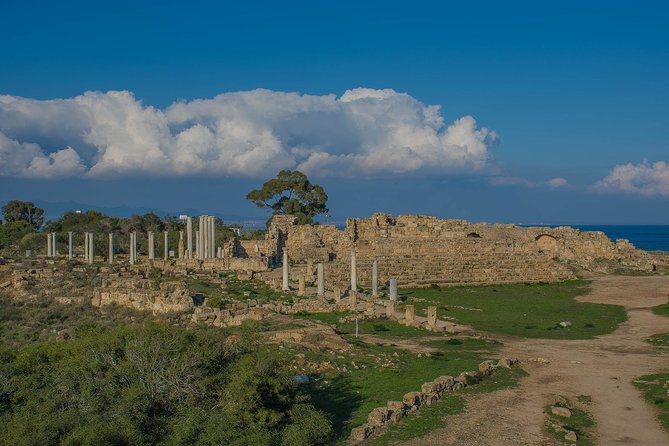
Salamis is the archaeological centerpiece of the eastern route. It was one of the most important ancient cities in Cyprus and passed through the hands of Assyrians, Egyptians, Persians, and Romans. During the Roman period, it became the island’s largest city, with more than 150,000 people recorded in the second century.
That number helps you picture the scale of the place. You are not simply looking at a small ruin beside the road. The remains point to a major urban center with public buildings, performance spaces, and bathing facilities.
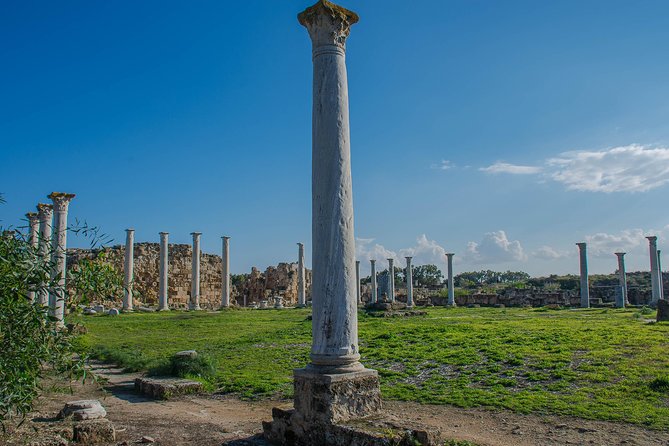
The Roman theatre and the gymnasium with its thermal baths are the key sights named for this visit. Together, they show the public side of ancient life: entertainment, exercise, social gatherings, and the practical comforts of heated water. Your guide can help turn broken columns and worn stone into something easier to imagine.
The scheduled visit is about 30 minutes, and admission is included. That is enough for an introduction and a few strong views, but you should not expect to examine the entire archaeological area at leisure. Wear practical shoes and be ready for an outdoor stop. The tour data does not specify the surface conditions or shade, so it is sensible to prepare for a site where you may spend time walking in the open.
For many people, Salamis will be the most rewarding stop because it offers physical scale and a clear sense of ancient civic life. If ruins are your main reason for booking, pay close attention here and ask your guide to point out the theatre, gymnasium, and baths early in the visit.
Famagusta Walled City and Lala Mustafa Pasha Mosque
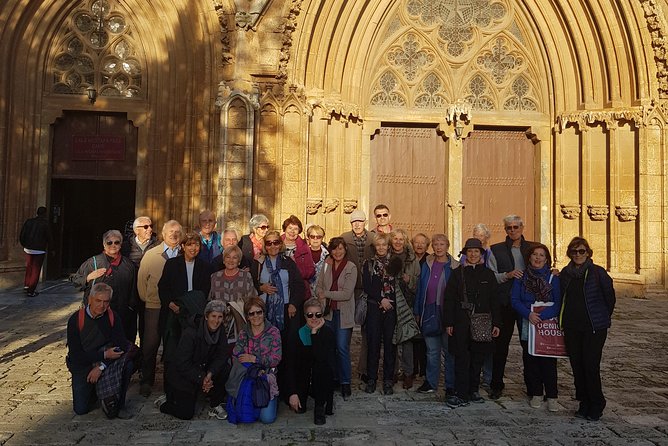
The old city of Famagusta is surrounded by historic walls and is often treated as an open-air museum. Your visit includes about 30 minutes inside the walled city, followed by a short 10-minute stop at Lala Mustafa Pasha Mosque.
The walled city brings together several centuries in a compact setting. Its most famous monument is the former Cathedral of St Nicholas, now called Lala Mustafa Camii. The building began as a 14th-century Gothic cathedral and was later converted into a mosque under Ottoman rule.
That change is central to understanding Famagusta. The building is not just a church or just a mosque. It reflects the shifting powers that shaped Cyprus, and its Gothic form recalls the great medieval churches of France. The exterior and setting are especially important because they show how European medieval architecture took root on the island.
The 10-minute mosque stop is brief. You may have enough time for a close look and an explanation from your guide, but not for a long architectural study. If the building is the highlight you most want to see, keep your questions focused and be ready to move on when the schedule calls.
Famagusta’s walls also deserve attention. They frame the old city and help explain its defensive importance. A guided visit is useful here because the remains are spread across a historic center rather than arranged as a single museum display.
A few more Cyprus trips worth comparing
- Private Discovery Dive + Photos & Videos
★ 5.0 · 577 reviews - Private Diving at Zenobia Wreck in Larnaka
★ 5.0 · 369 reviews - Self-drive Amathunta Private Speedboat to Blue Lagoon, Caves etc
★ 5.0 · 161 reviews - Luxury Eden 18 Private Self-drive boat hire to Blue Lagoon & more
★ 5.0 · 148 reviews
Varosha and the meaning of a ghost town
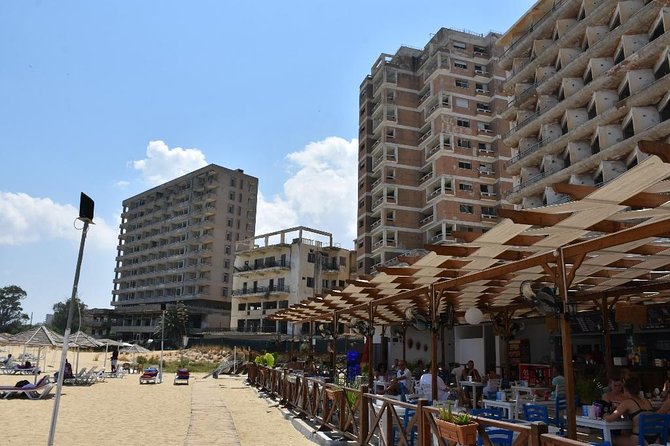
The stop at Varosha lasts about 10 minutes. Before the division of Cyprus in 1974, Varosha was a successful tourist resort. After 1974, it came under Turkish control and the resort area was left abandoned, becoming known as a ghost town.
This is one of the most politically charged sights on the route. You are not simply seeing old holiday buildings. You are looking at a place shaped by conflict, displacement, and the division of Cyprus. The short stop allows you to take in the basic story without turning the day into a lengthy political tour.
Your guide’s perspective can make a real difference here. Sedat, who was described as having lived through the 1974 war, brings personal memory to a subject that can otherwise feel abstract. That does not replace learning the wider history, but it can help you understand why the subject still matters.
Keep your expectations realistic. The tour information gives no promise of an extended walk through Varosha, and the listed stop is only 10 minutes. You should view it as a brief, meaningful look at a major modern chapter in Cyprus rather than a full exploration.
Crossing into North Nicosia’s old city
The Nicosia portion begins with the Kyrenia Gate, one of the three original gates in the city walls. The Venetians built it in the 16th century as part of the newer defensive walls, and its historic name was Porta del Proveditore.
This is a useful point of entry because city gates explain how Nicosia was organized and defended. You get a sense of the old capital as a walled city rather than a modern urban area that happens to contain old buildings.
The tour then continues to Selimiye Mosque, formerly the Cathedral of Saint Sophia. It is described as the largest and oldest surviving Gothic church in Cyprus, and it remains North Nicosia’s most prominent landmark. Its story reaches back to the 13th century, with architecture influenced by the medieval cathedrals of France.
The visit lasts about 15 minutes and admission is free. That is enough to appreciate the building’s scale and hear the basic story of its conversion from cathedral to mosque. As with Lala Mustafa Pasha Mosque, the short timing means you should focus on the main architectural features and let the guide supply the context.
The contrast between the two former cathedrals is one of the day’s best features. Famagusta and Nicosia each show how religious buildings can change use while retaining earlier architectural forms. Seeing both helps you compare the two cities rather than treating them as unrelated stops.
Buyuk Han and the Ottoman market quarter
Buyuk Han, or the Great Inn, is the final major stop. This 16th-century Ottoman building sits in the traditional market center inside Nicosia’s city walls. It is the largest inn on Cyprus and one of only two surviving inns on the island that retain their original shape and appearance.
An inn like this was built for movement, trade, and lodging. Its importance is not limited to the building itself. Buyuk Han helps you picture how merchants and visitors used the old city, with a central place for commerce and rest.
The planned visit is about 15 minutes, with no admission fee. That is a quick look, but the building’s form is easy to grasp in a short time. You can see the courtyard arrangement, listen to the guide, and get a feel for the old market center.
If you enjoy historic urban spaces, Buyuk Han may be one of the most pleasant stops of the day. It gives the itinerary a human scale after the larger ruins and imposing religious buildings. The schedule still moves quickly, so do not count on a long independent wander unless the guide has flexibility.
The guide makes or breaks the experience
The strongest praise for this tour centers on the guides, not just the monuments. One guide, described as a schoolteacher, explained the history of Cyprus while also drawing on personal experience of the 1974 war. That combination of formal teaching and lived memory can give difficult subjects more clarity.
Another guide, Cemal, was described as arriving on time, sharing historical information during the drive, and keeping the day pleasant. That matters because the route includes substantial time in the vehicle. A guide who talks naturally between stops helps the travel time feel useful rather than lost.
A third account praised a female guide for being friendly, welcoming, and informative. The exact guide assigned to your group can vary, so you should not assume you will receive a particular person. Still, the pattern is clear: the company’s guide service is a major reason to consider a private tour.
You should use that private format. Ask about the 1974 division, the change from cathedral to mosque, the different powers that controlled Salamis, or the purpose of Buyuk Han. You are paying for more than a driver, and questions turn a quick sightseeing route into a more meaningful day.
Is $222.29 per person a fair price?
At $222.29 per person, this is not a budget bus outing. The value depends heavily on your group size and what you would otherwise need to arrange.
The price includes hotel pickup where available, transportation for your private group, a guide, lunch, and all entrance fees. That removes several small costs that can add up during a long day. You also avoid arranging separate transport to Salamis, Famagusta, Varosha, and Nicosia.
A private tour is usually easier to justify for two or more people who value control, questions, and a quieter vehicle. If you are traveling alone, the price per person may feel high compared with a shared excursion. Group discounts are offered, but the exact reduced price is not provided, so you should check the current total before booking.
The tour also saves planning time. You do not need to build a route between sites, work out the order, or keep track of entrance payments. For a first visit to northern Cyprus, that convenience has real value.
The tradeoff is time at each monument. You are paying for broad coverage and private guiding, not an extended visit to every site. If you prefer to spend half a day at Salamis alone, a shorter or more specialized excursion may suit you better.
Pickup, timing, and practical details
The official meeting point is in front of the ticket office at Baldöken Car Park, Ziya Rızkı Cd 95, in Kyrenia City Centre. The tour starts at 9:00 a.m. and returns to the same meeting point after roughly eight to nine hours.
Hotel pickup and drop-off are offered, but only within the stated service area: Kyrenia, Alsancak, Lapta, and Çatalköy. Contact the provider with your exact hotel location before relying on collection. One pickup was arranged from the Bellapais Hotel, while another was made from a hotel near an Airbnb in Alsancak, showing how useful advance confirmation can be.
The experience is offered in English. It is a private activity, so only your group participates. Most people can take part, and the meeting point is near public transportation, although the supplied details do not specify the exact walking or vehicle arrangements for each site.
Bring comfortable footwear and keep your schedule open for the full day. The many short stops mean you should be ready to get out, listen, look around, and return to the vehicle without delay. Lunch is included, which is helpful on a route with no need to search for a meal in the middle of the day.
The booking is non-refundable and cannot be changed for any reason. That makes it wise to confirm your pickup location, date, and group details before paying.
Who should book this private Cyprus tour?
I would recommend this tour if you are staying in Kyrenia and want one organized day covering ancient, medieval, Ottoman, and modern Cyprus. It is especially useful if you want to see both Famagusta and North Nicosia without managing transport yourself.
It suits you best if you value a guide’s explanation as much as the buildings. The personal accounts from guides such as Sedat and Cemal suggest that the driving time can add useful context, particularly on the island’s division and 1974.
Families, couples, and small groups may appreciate the private setup. You can ask questions without worrying about a large coach group, and group discounts may improve the price. The route also works for a first visit when you want to identify the places where you might return later.
I would hesitate if you dislike long days, quick stops, or emotionally difficult modern history. Varosha is brief but serious, and the itinerary does not give you much unstructured time. Archaeology specialists may also want a tour devoted mainly to Salamis, with more time among the ruins.
Should you book it?
Book this experience if you want a well-organized first look at eastern and northern Cyprus, with lunch, entry fees, and transport handled in one price. The private guide format is its biggest strength, particularly if you enjoy asking questions about Cyprus’s complicated past.
Skip it if your ideal day means lingering at one site, taking long photographs, or exploring Famagusta and Nicosia independently. For everyone else, the combination of Salamis, the Famagusta walls, Varosha, and North Nicosia gives you an unusually wide view of the island in a single day.
FAQ
Where does the Famagusta and Nicosia tour start?
The tour starts at 9:00 a.m. in front of the ticket office at Baldöken Car Park, Ziya Rızkı Cd 95, in Kyrenia City Centre.
Does the tour return to Kyrenia?
Yes. The activity ends back at the meeting point in Kyrenia.
Is hotel pickup available?
Yes. Hotel pickup and drop-off are offered from hotels in the Kyrenia region, including Alsancak, Lapta, and Çatalköy. You should contact the provider with your exact location.
How long does the experience last?
The tour lasts approximately eight to nine hours.
Is this a private tour?
Yes. Only your group participates in the activity.
Is lunch included?
Yes. Lunch is included in the tour price.
Are entrance fees included?
Yes. Entrance fees for the included paid attractions are covered. Several other stops have free admission.
What language is the tour offered in?
The tour is offered in English.
Can I cancel or change the booking?
No. The experience is non-refundable and cannot be changed for any reason after booking.
Recently added around Cyprus
- Private cruise with a sailing yacht Koursaros★ 5.0 · 3 reviews
- Taxi transfer from LCA airport to Ayia Napa or Ayia Napa to LCA airport★ 5.0 · 3 reviews
- Luxury Wine tasting at your place in Cyprus★ 5.0 · 3 reviews
- Discover Heritage of Cyprus: Private Tour from Limassol★ 5.0 · 4 reviews
- Pafos and Kourion Coach Excursion in Italian★ 4.0 · 3 reviews
- Private Full-Day Tour in Larnaca with Hotel Pick Up★ 5.0 · 4 reviews
- Watch the stunning sunset over the Akamas on a luxury Speedboat.★ 5.0 · 4 reviews
- Self Drive from Latchi to Blue Lagoon Boat Rental★ 5.0 · 4 reviews
Northern Cyprus Tours, compared.
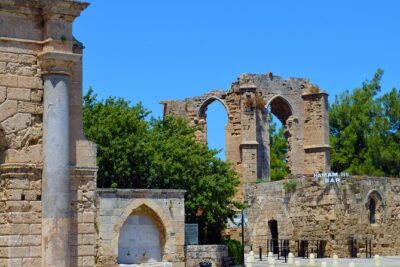
Ghost-Town Famagusta Mini Bus Tour from Protaras and Ayia Napa
Read our review →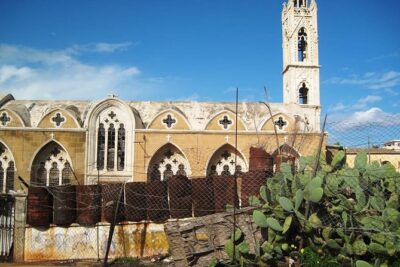
Full-day Famagusta: Lost Cities & Coastal Secrets from Paphos
Read our review →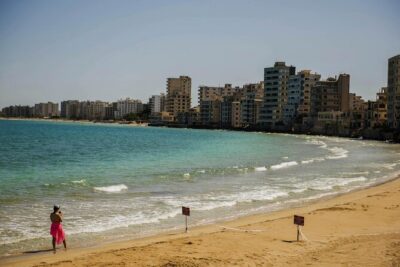
Red Bus Varosha experience in English from Ayia Napa, Protaras
Read our review →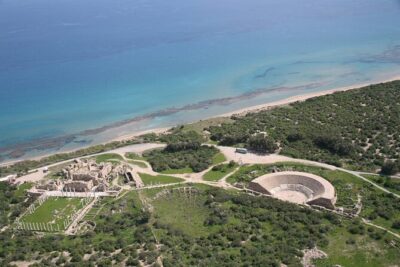
Day Tour to Famagusta, Ghost Town & Ancient Salamis
Read our review →
A Day Trip to Medieval FAMAGUSTA (Kyrenia, Nicosia or Famagusta )
Read our review →
Browse the lists this tour appears in